Stop Writing Campaigns from Scratch: Meet the Marketing Campaign & Sequence Manager Agent

You know the drill. Marketing wants a 5-email drip sequence for the product launch. Sales needs a re-engagement campaign for stalled deals. Your SDR manager is asking for a new cold outbound sequence because reply rates tanked last month. And somehow, you're supposed to write, segment, schedule, and track all of it — while also doing everything else on your plate.
So you open a Google Doc, stare at a blinking cursor, and spend the next three hours cobbling together subject lines that may or may not get opened. The copy feels generic. The cadence is guesswork. And by the time the campaign actually launches, the moment has passed.
That's exactly why we built the Marketing Campaign & Sequence Manager Agent.
What Is the Marketing Campaign & Sequence Manager Agent?
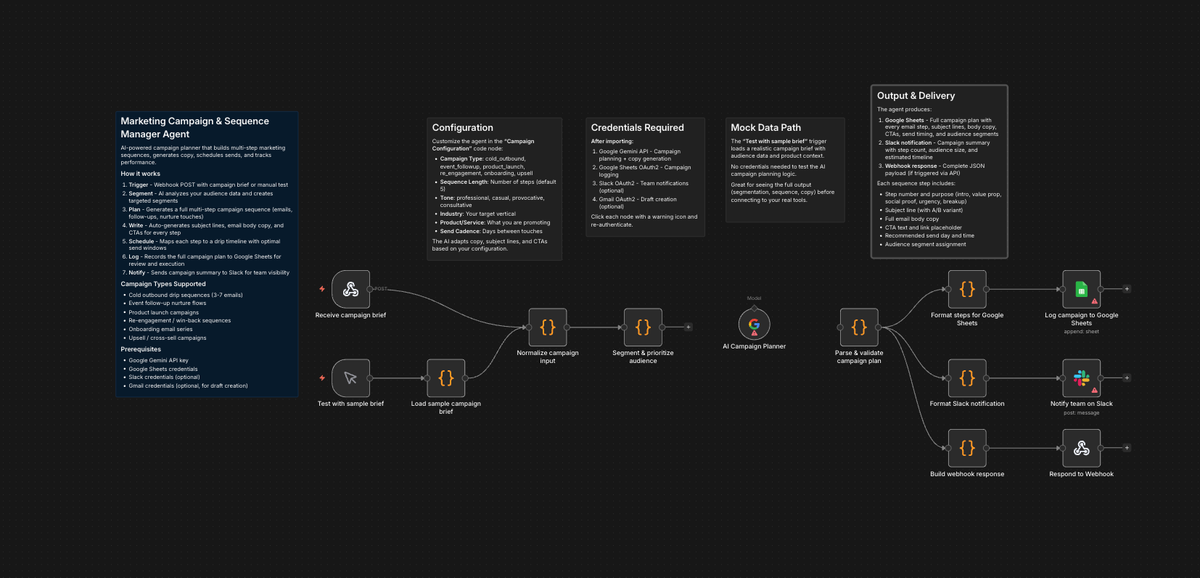
The Marketing Campaign & Sequence Manager Agent is an AI-powered n8n workflow that takes a campaign brief — your product, audience segments, goals, and tone — and generates a complete, ready-to-execute multi-step email sequence. We're talking subject lines with A/B variants, full email body copy, personalized CTAs, send timing recommendations, audience segmentation, follow-up rules, and performance benchmarks. All in one automated pass.
This isn't a template library you browse. It's a system that builds the campaign for you, customized to your product, your audience, and your competitive landscape.
How It Works: The "Campaign Factory" Stack
- The Brain — Gemini 2.5 Flash receives your full campaign brief — product details, audience pain points, competitive positioning, tone preferences — and generates a complete multi-step sequence. Temperature is set to 0.5 for the right balance of creativity and consistency. Every email step includes a strategic purpose (pattern interrupt, value prop, social proof, urgency, breakup) so the sequence tells a coherent story, not just a series of disconnected pings.
- The Audit Trail — Every campaign generated is logged with timestamps, model metadata, and the original brief. Over time, this becomes your campaign playbook — a library of AI-generated sequences you can reference, remix, and improve. When you find a subject line pattern that consistently hits 40% open rates, you'll have the data to prove it.
- The Delivery — The finished campaign plan lands in two places. Google Sheets gets the full breakdown — every step, every subject line, every email body, send day, target segment, and follow-up rule — laid out as a ready-to-execute campaign tracker. Slack gets a formatted summary so your team can review the plan without digging through a spreadsheet. If triggered via webhook, the complete JSON payload is returned for direct integration with your email platform.
- The Segmentation Engine — Before copy is generated, a dedicated segmentation node analyzes your audience data and assigns priority tiers. Each segment gets a messaging angle derived from their specific pain points. A VP of Sales hears about pipeline coverage and rep productivity. A RevOps leader hears about CRM automation and reporting overhead. Same product, different story — which is exactly how campaigns should work.
Why It Matters for Marketing and Sales Teams
1. You launch campaigns in minutes instead of days. The average B2B marketing team spends 8-12 hours planning and writing a single drip sequence. Between stakeholder input, copy iterations, and scheduling logistics, a week can disappear before the first email sends. The Campaign Manager Agent compresses that to minutes. Feed it the brief, review the output, and you're live. That speed advantage compounds when you're running multiple campaigns across segments.
2. Every sequence is strategically structured, not ad-hoc. Most email sequences are thrown together based on vibes. "Send 5 emails over 3 weeks" isn't a strategy. The agent builds each sequence with purpose-driven steps — introduction with a pattern interrupt, deep value proposition, social proof and case studies, scarcity or urgency, and a professional breakup. Each step has follow-up rules tied to engagement behavior (opened but didn't click, didn't open at all, clicked but didn't convert). That's the difference between "we sent some emails" and "we ran a campaign."
3. Your campaigns get smarter over time. Because every generated campaign is logged with its settings, audience data, and performance targets, you build an institutional knowledge base. The optimization suggestions built into each plan — things like "test question-based vs. statement subject lines for the SDR Manager segment" — give your team specific hypotheses to run. After a few cycles, you're not starting from scratch anymore. You're iterating on what works.
Get the Template
Subscribe to our newsletter below to get the Marketing Campaign & Sequence Manager Agent template link for free. Import it into your n8n instance, plug in your campaign brief, and watch it generate a complete multi-step sequence ready for review and execution.
And if you want this integrated directly with your email platform — whether that's HubSpot Sequences, Outreach, Instantly, or Mailchimp — that's what we do at Scoot. We build custom AI agents that plug into your existing marketing stack. No migration headaches. Just automation that runs the way your team already works.