AI Sales Agents: Build vs. Buy
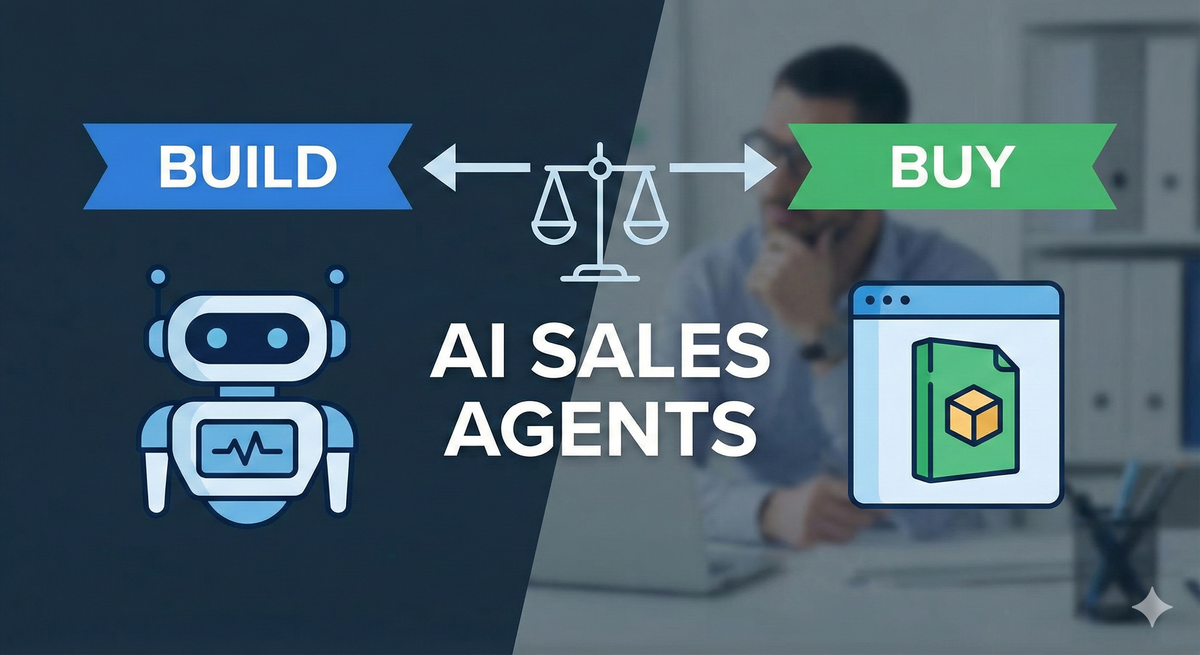
Many companies outsource functions that are not core to their business. Buying a product or service from a third party can be more cost efficient, thanks to specialization and economies of scale. Fewer distractions allow management to serve customers better by focusing on the handful of things a company does uniquely well.
Software is something most companies buy, rather than build. Almost no company makes their own operating system, email server, spreadsheet program, accounting software, or payroll system.
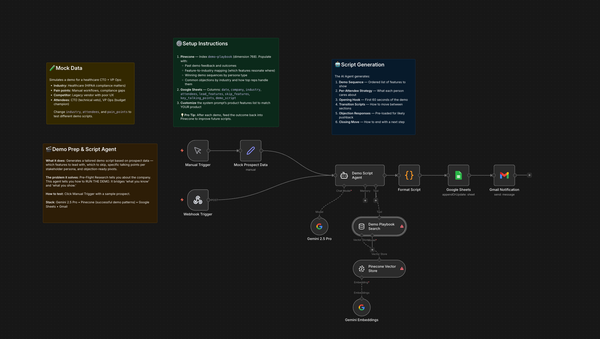
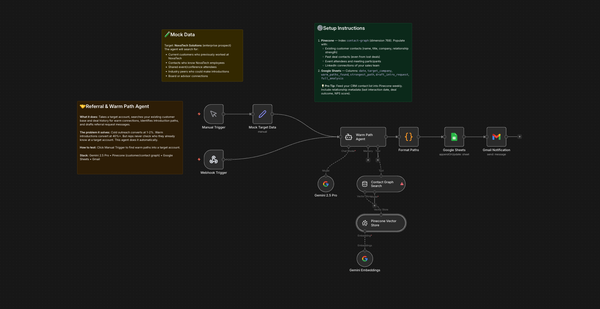
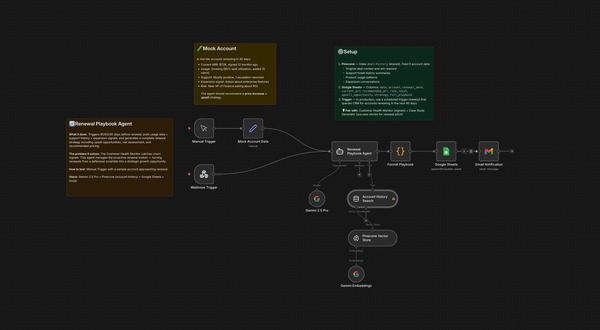
AI sales agents look like software at first glance. They run workflows, store data, and do tasks that humans might otherwise do. Building and deploying an AI agent takes some technical skills, too. Not everyone knows how to do it.
What makes AI sales agents interesting, though, is that they also look a lot like people. They have a level of intelligence. They interact with prospects and customers. They offer suggestions, solutions, and options.
If you work in a business, you almost certainly outsource your CRM system (Salesforce, Hubspot). But do you outsource your sales force itself? Most companies don't, and for good reasons.
Sales is a front-line, customer-facing function. Sales engages with the market and figures out what has to happen to beat the competition and win customers. Markets are constantly evolving. Competitors are getting stronger, or weaker. Prices shift. New products arrive, and old products go away.
Even if a company uses distributors or resellers, they typically maintain a Sales function that works with partners to stay on top of things. And they often have a direct sales force as well.
If you wouldn't outsource Sales, should you outsource AI sales agents?
Before answering this question, a disclaimer: this article is not going to be the final word on this topic. And as we've mentioned before, there can be good reasons to buy AI agents instead of building them. It might be faster to buy than build. And it may be that a vendor has a product that is almost exactly what you would build for yourself.
However, there are some really good reasons to build your own AI agents. Here are a few to consider:
1. Granular Control Over "Sales DNA"
Vendor solutions usually come pre-trained with generic sales methodologies. By building your own, you can encode your company’s specific "Sales DNA"—your unique objection handling, specific value propositions, and the subtle nuances of your top performers. You aren't just automating a sales process; you are automating your sales process.
2. Deep Integration with Custom Tech Stacks
Most vendor agents integrate well with Salesforce or HubSpot but struggle with proprietary databases, legacy ERPs, or niche industry tools. A custom build allows your agent to read and write data directly to any system you use, ensuring the agent has perfect context on inventory, shipping times, or customer history without manual syncing.
3. Data Sovereignty and Privacy
Sales data is sensitive. Using a vendor often means sending your customer interactions and PII (Personally Identifiable Information) to their cloud, subjecting you to their privacy policies. Building in-house allows you to keep data within your own VPC (Virtual Private Cloud), ensuring strict compliance (GDPR, HIPAA, SOC2) and eliminating third-party data leakage risks.
4. Elimination of Per-Agent Licensing Fees
SaaS vendors typically charge per "seat" or per "interaction." As you scale your AI workforce to handle thousands of leads, these costs can balloon linearly. Building your own requires an upfront investment, but the marginal cost of spinning up the 1,000th agent is negligible compared to paying a vendor for 1,000 licenses.
5. Competitive Differentiation
If you and your competitor both buy the same AI sales tool, you are effectively competing with the same salesperson. Building your own allows you to create capabilities your competitors literally cannot copy, turning your sales infrastructure into a defensible moat rather than a standard utility.
6. Agility in Strategy Pivots
When your market shifts, vendor roadmaps may not move fast enough. If you need to change your pricing model, territory logic, or product focus overnight, you can re-prompt or fine-tune your internal model immediately. You don't have to wait for a vendor to release a feature update to support your new strategy.
7. Avoidance of Platform Lock-In
Relying on a vendor for core revenue-generating activities creates a dangerous dependency. If that vendor raises prices, shuts down, or pivots their focus, your sales pipeline is held hostage. Owning the code ensures business continuity and protects you from external platform risk.
8. Precision in Brand Voice and Tone
Generic LLM wrappers can sound robotic or overly enthusiastic in a way that feels "fake." A custom build allows you to fine-tune the temperature and style of the model to match your exact brand voice—whether that is professional and consultative, or witty and casual—ensuring a consistent customer experience.
9. Retention of Institutional Knowledge
When a human salesperson leaves, they take their knowledge with them. When a vendor updates their model, the behavior changes. With a custom agent, every successful interaction, every handled objection, and every closed deal is fed back into your training dataset. Your organization effectively "learns" forever, retaining knowledge permanently.
10. Unrestricted Experimentation
Vendors often put guardrails on what their agents can do (e.g., rate limits, restricted API access). Building your own lets you experiment with radical ideas—like having agents generate personalized video content, browse the live web for prospect news in real-time, or interact with leads on non-standard channels (like WhatsApp or Telegram) exactly how you see fit.
Conclusion
If you consider Sales to be a core function in your business, then you probably should consider your AI sales agents to be core to your business as well.
AI sales agents may look like software, but there are fewer economies of scale in buying them. The software to run agents is not expensive or too complicated. The training and knowledge agents need is the same, whether you build or buy.
Interested in how to build your own AI sales agents? Read this as a starting point: Learn to Build your own Agents